

To submit an appraisal as admissible evidence, you need a full Appraisal Report (not a restricted form), a USPAP-compliant statement, a state-certified appraiser's signed certification with license number, a correct effective date tied to the legal event, and timely pretrial disclosure with the appraiser listed as a witness. Miss any one of these and opposing counsel has grounds to move for exclusion before you ever reach the merits.
Here's the step-by-step legal appraisal submission checklist you need:
- Commission a full Appraisal Report. USPAP requires a complete narrative report for litigation; restricted or summary formats are not acceptable for court use.
- Confirm the intended use and intended user in writing before the appraiser begins work. The report must state the court or legal proceeding as the intended use.
- Verify the effective date matches the legal event — date of separation, date of death, or filing date. A wrong effective date is one of the most common reasons a report gets challenged.
- Obtain the signed certification with the appraiser's state license number and USPAP compliance statement.
- Compile standalone exhibits: comparable sales table, dated photographs with captions, legal description, and survey.
- Produce an exhibit list and assign exhibit numbers consistent with your pretrial disclosure package.
- Disclose the appraisal and exhibit list to opposing counsel and the court by the applicable deadline (in NJ tax appeals, written reports must be provided at least seven calendar days before the hearing).
- List the appraiser as a witness on your witness disclosure. An appraisal submitted alone is hearsay and subject to exclusion.
- Subpoena the appraiser if they are not a retained expert under your direct control, to secure their appearance for authentication.
- Prepare a brief appraiser CV and attach it to the exhibit package so the court can assess qualifications under FRE 702/Daubert.
- Serve copies on opposing counsel and file with the court clerk per local rules (e-filing or physical, depending on jurisdiction).
- Coordinate with your attorney early. Assignment parameters — intended use, effective date, legal interest — must be locked in writing before the appraiser starts.
Pro Tip: Get the attorney and appraiser on a call before the engagement letter is signed. Confirming the intended use, effective date, and legal interest in that first conversation prevents the most common admissibility problems. FRE 702 and Daubert screen for methodology, not just the final number, so the appraiser's process must be documented from day one.
Key Takeaways
A court-ready legal appraisal submission requires a full USPAP-compliant report, correct effective date, state-certified appraiser credentials, timely pretrial disclosure, and live authentication through the appraiser's testimony.
| Point | Details |
|---|---|
| Full Appraisal Report required | USPAP prohibits restricted or summary formats for litigation; only a full narrative report is court-acceptable. |
| Effective date must match the legal event | Date of death, separation, or filing date must be exact; a mismatch is a common exclusion trigger. |
| Appraiser authentication is mandatory | An appraisal alone is hearsay; list the appraiser as a witness and subpoena them if not a retained expert. |
| NJ tax board deadline is seven days | Written appraisal reports must reach the board and opposing parties at least seven calendar days before the hearing. |
| Newjerseyrealestateappraisal provides court-ready reports | State-certified, USPAP-compliant litigation appraisals with standalone exhibits and testimony availability across all 21 NJ counties. |
Table of Contents
- When do you actually need a court-ready appraisal?
- How do you prepare a court-ready, USPAP-compliant appraisal report?
- How do you actually get an appraisal admitted into evidence?
- What are the typical timelines and costs for a court-ready appraisal in NJ?
- How do you prepare the appraiser for deposition and trial testimony?
- How does Newjerseyrealestateappraisal produce court-ready appraisals?
- What actually makes an appraisal defensible in court
- Newjerseyrealestateappraisal handles court-ready appraisals across New Jersey
- Sources
When do you actually need a court-ready appraisal?
Not every legal matter requires a full litigation-grade report, but several common situations do. Ordering the right type from the start saves time and avoids having to commission a second report.
Common legal uses that require a court-ready appraisal:
- Divorce and equitable distribution — NJ courts require a defensible value for marital real property; a lender form won't survive cross-examination.
- Probate and estate administration — date-of-death valuations must be retrospective and USPAP-compliant for IRS and court acceptance.
- Property tax appeals — county tax boards require written appraisal reports and appraiser testimony.
- Eminent domain proceedings — the government's offer must be countered with a credentialed, defensible valuation.
- Commercial disputes and partnership dissolutions — courts need an impartial valuation with traceable methodology.
- Settlement negotiations — even pre-litigation, a court-ready report carries more weight than a broker opinion.
Timing matters more than most people realize. A retrospective valuation (one with an effective date in the past) requires archived MLS data, historical market reports, and listing histories that may become harder to source as time passes. Commission the report as soon as the legal need is identified, not after discovery closes.
The clearest sign you need a court-ready report rather than a standard lender form: the intended user is a court, a judge, opposing counsel, or a government body. If the report will be read by anyone other than a lender making a loan decision, it needs full Appraisal Report documentation and USPAP compliance.
Pro Tip: If you're unsure whether your situation requires a full litigation report, ask the appraiser to confirm the intended use in writing before any work begins. Early coordination between attorneys and appraisers — documenting intended use, effective date, and legal interest — substantially reduces the risk of an inadmissible report.
How do you prepare a court-ready, USPAP-compliant appraisal report?
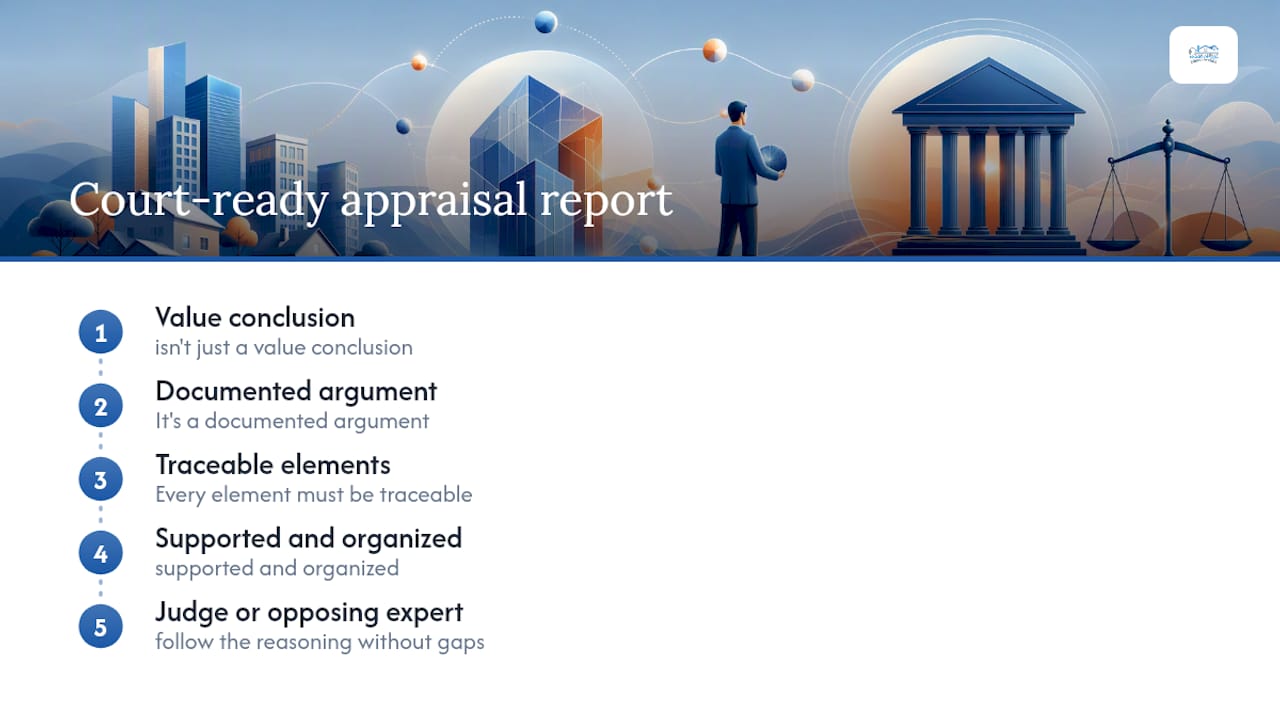
A defensible appraisal isn't just a value conclusion. It's a documented argument, and every element must be traceable, supported, and organized so a judge or opposing expert can follow the reasoning without gaps.
Step 1: Define the assignment in writing
Before any fieldwork, document these four items in the engagement letter:
- Intended use — state the specific legal proceeding (e.g., "equitable distribution in Superior Court of New Jersey").
- Intended user — name the court, the parties, and counsel.
- Legal interest being valued — fee simple, leasehold, partial interest.
- Effective date — must match the legal event precisely. A wrong date is a common exclusion trigger.
Step 2: Build the full Appraisal Report narrative
USPAP Standards 9 and 10 require complete disclosure for litigation reports; a restricted or summary form is not acceptable. The report must include:
- Scope of work (documented in writing, not implied)
- Site and improvement description with legal description
- Neighborhood and market analysis with sourced data
- Sales comparison approach with a comps table and adjustment support
- Income and/or cost approach where applicable
- Quantified adjustment support (paired-sales analysis or regression data)
- Reconciliation of value indications
- Signed certification with state license number and USPAP compliance statement
Step 3: Add evidence-level exhibits as standalone documents
Each exhibit should stand alone so it can be introduced separately if needed:
- Comparable sales table (labeled Exhibit A, B, etc.)
- Dated photographs with captions identifying each subject
- Survey or legal description
- Market data sources (MLS printouts, public records, dated reports)
- Intermediate calculations supporting adjustments
- Work file reference list (not the full file, but a log of what exists)
A court-ready appraisal must align the effective valuation date precisely with the legal event — date of death, date of separation, or filing date. Using the wrong date is one of the most common reasons a report is challenged or excluded. Opposing counsel will check this first.
Step 4: Apply formatting best practices
Pagination, exhibit labeling, and indexing aren't cosmetic. A judge reading a 60-page report needs to find the comps table in under 30 seconds. Use a table of contents, sequential page numbers, and a labeled exhibit index at the front. Redact any privileged attorney-client communications from the work file before producing it.
Pro Tip: For retrospective valuations, build your data file at engagement, not at report delivery. Archived MLS records, dated market reports, and listing histories can disappear or become harder to authenticate months later. Document your sources with timestamps the moment you pull them.
Missing methodology explanation, undisclosed data sources, or unsupported adjustments are the three weaknesses opposing counsel targets first. Every adjustment must be quantified and sourced — "market conditions" as a standalone explanation won't survive cross-examination.
How do you actually get an appraisal admitted into evidence?
Submit the appraisal as a marked exhibit and authenticate it through the appraiser's testimony. That's the standard path. Everything else is a variation on that rule.
An appraisal submitted without a sponsoring witness is hearsay and subject to exclusion. The two exceptions are a stipulation with opposing counsel (both sides agree the report is authentic) or a business-records affidavit where local rules permit it. Neither exception is guaranteed, so plan for live testimony.
Pretrial disclosure steps
- Exchange the appraisal report and exhibit list with opposing counsel by the court's deadline.
- File the exhibit list with the court clerk in the required format (e-filing or physical per local rules).
- Serve the required number of copies — most NJ Superior Court matters require at least one copy for the court and one for each opposing party.
- List the appraiser on your witness disclosure with their full name, license number, and a brief description of expected testimony.
Authentication strategies
- Subpoena the appraiser — required if they are not a retained expert under your direct engagement. Issue the subpoena early; appraisers have calendars.
- Affidavit of authenticity — some courts accept a signed declaration from the appraiser confirming the report is their work product, reducing the need for live testimony on foundational issues.
- Stipulation with opposing counsel — agree in writing that the report is authentic, reserving objections to weight and methodology only.
A sample exhibit-entry line for your exhibit list: "Exhibit 12: Appraisal Report of [Property Address], prepared by [Appraiser Name], State Certified General Appraiser License No. [XXXXXXXX], effective date [MM/DD/YYYY], USPAP-compliant."
Courts apply Daubert and FRE 702 gatekeeping standards that focus on methodology testability, peer acceptance, known error rates, and data reliability. The final value number is almost secondary — a judge can exclude a report entirely if the methodology isn't documented and defensible. This is why the report structure in Section 3 matters as much as the procedural steps here.
Pro Tip: Prepare a clean exhibit binder with a printed exhibit index for the court clerk and the judge. Number your tabs to match your exhibit list exactly. A disorganized binder creates unnecessary friction and signals to the court that the evidence package wasn't prepared carefully.
What are the typical timelines and costs for a court-ready appraisal in NJ?
Court-ready appraisals take longer and cost more than standard lender reports. Plan for both.
Typical NJ turnaround times:
- Standard residential court-ready report: 7–14 business days from inspection
- Retrospective or date-of-death valuation: 10–21 business days (data sourcing adds time)
- Complex commercial or multi-family: 3–6 weeks depending on property type and data availability
Court scheduling adds another layer. If your trial date is six weeks out, commission the report now, not in three weeks.
Typical fee ranges (NJ, subject to case complexity):
- Residential litigation appraisal: generally higher than a standard lender report due to expanded narrative and exhibit preparation
- Estate/divorce appraisal: retainer often required upfront; expert testimony billed separately at hourly rates
- Commercial litigation appraisal: fees vary significantly by property type, size, and required approaches
Filing logistics and deadlines:
- NJ county tax board appeals: written appraisal reports must be provided to the board and opposing parties at least seven calendar days before the hearing; the appraiser must be present to testify.
- NJ Superior Court (divorce, probate, commercial): exhibit exchange deadlines are set by the case management order; confirm with counsel.
- Subpoenas: issue at least 2–3 weeks before the hearing date to allow for scheduling.
| Milestone | Typical Timing |
|---|---|
| Commission appraisal | As early as possible after legal need identified |
| Inspection and data collection | Within 1–5 business days of engagement |
| Report delivery | 7–21 business days post-inspection |
| Exchange with opposing counsel | Per court order or 7+ days before hearing (tax board) |
| Subpoena issued | At least 2–3 weeks before hearing |
| Appraiser testimony | At hearing or trial date |
How do you prepare the appraiser for deposition and trial testimony?
The appraiser must be able to explain their methodology, data sources, and adjustments clearly and concisely under cross-examination. That ability doesn't happen automatically — it requires preparation.

Start with a scope-of-work walkthrough with the hiring attorney. The appraiser should be able to explain every adjustment, every comp selection, and every data source in plain language before they sit in the witness chair.
Deposition preparation checklist
- Confirm the appraiser has a current CV listing credentials, license number, and relevant experience.
- Provide the appraiser with a copy of the full report and all exhibits.
- Review the engagement letter and retainer details — opposing counsel will ask about compensation.
- Walk through the methodology section line by line with the attorney.
- Identify the two or three adjustments most likely to be challenged and prepare concise explanations.
- Confirm the appraiser will bring only the report, CV, and key exhibits — not the full work file unless specifically requested.
Trial preparation checklist
- Professional attire; arrive early to review the courtroom setup.
- Bring three copies of the report: one for testimony reference, one for the court, one spare.
- Bring the exhibit binder with labeled tabs matching the exhibit list.
- Review the direct examination questions with counsel the day before.
Sample direct examination questions the appraiser should rehearse:
- "What is your professional background and license status?"
- "What was the effective date of this appraisal and why was that date selected?"
- "What approaches to value did you use and why?"
- "How did you select the comparable sales?"
- "How did you support your adjustments?"
Sample cross-examination questions to prepare for:
- "Isn't it true that comparable sale #3 sold 18 months before your effective date?"
- "You were paid by the plaintiff — doesn't that create a bias?"
- "Your adjustment for condition is $15,000 — what data supports that specific figure?"
Judges expect 'educated subjectivity' from an appraiser — a defensible, unbiased document with transparent methodology and traceable data. The appraiser's job is not to win a number for their client; it is to explain the market evidence clearly and let the analysis speak. Advocacy language in the report or testimony undermines credibility immediately.
Pro Tip: Instruct the appraiser to answer only what is asked — no volunteering, no elaboration beyond the question. Short, direct answers under cross-examination are far more credible than lengthy explanations that open new lines of attack.
How does Newjerseyrealestateappraisal produce court-ready appraisals?
Newjerseyrealestateappraisal delivers state-certified, USPAP-compliant, court-ready appraisal reports across all 21 New Jersey counties and will testify when required. Our standard litigation workflow is built around the procedural steps in this guide.
Our process for litigation assignments:
- Written engagement letter confirming intended use, intended user, effective date, and legal interest before any work begins.
- Full Appraisal Report narrative — never a restricted or summary form for court assignments.
- Standalone exhibits prepared as separately labeled documents: comps table, dated photographs, legal description, and market data sources.
- Quantified adjustment support with documented data sources, not unexplained line items.
- Signed certification with state license number and USPAP compliance statement.
- Work-file retention and availability to testify at deposition or trial.
Our proof points:
- State-certified appraisers covering residential, multi-family, commercial, divorce, estate, date-of-death, retrospective, and tax appeal assignments.
- USPAP-compliant reports that meet FRE 702/Daubert documentation standards.
- 26+ years of combined NJ real estate experience across all 21 counties.
- Litigation support assignments accepted for Superior Court, county tax boards, and federal matters.
You can review our approach to compiling legal-ready appraisals in New Jersey or request a sample court-ready report directly.
Pro Tip: Ask your appraiser for a sample exhibit index and report table of contents before engagement. If they can't produce one, that's a signal the report may not be organized for court use.
What actually makes an appraisal defensible in court
Most appraisal challenges aren't about the value conclusion. They're about the paper trail behind it.
We've seen reports excluded not because the appraiser was wrong about value, but because an adjustment wasn't quantified, a data source wasn't disclosed, or the effective date didn't match the legal event. Those are procedural failures, and they're entirely preventable with early coordination.
The principle we apply at Newjerseyrealestateappraisal is defensibility over a target number. Every adjustment must be traceable. Every data source must be named. Every assumption must be documented in the scope of work. A report that can withstand cross-examination isn't just better evidence — it's a more accurate reflection of the market.
Early involvement matters. When the attorney and appraiser align on assignment parameters before any fieldwork begins, the risk of an inadmissible report drops substantially. Coordinate with counsel and your appraiser at the start of the case timeline, not after discovery has closed.
Newjerseyrealestateappraisal handles court-ready appraisals across New Jersey
When a legal matter turns on property value, you need a state-certified appraiser who understands both the valuation process and what courts require. Newjerseyrealestateappraisal provides court-ready, USPAP-compliant appraisal reports for divorce, estate, tax appeal, commercial disputes, and eminent domain matters throughout New Jersey.

We prepare evidence-grade reports with standalone exhibits, signed certifications, and full Appraisal Report narratives. Our appraisers are available to testify at deposition and trial. We cover all 21 NJ counties, including estate and date-of-death appraisals and tax appeal appraisals with county board deadline compliance built in.
To schedule a litigation appraisal or discuss your assignment, contact us at (908) 517-3913 or visit Newjerseyrealestateappraisal. Retainers are required for litigation assignments; scheduling is available on short notice for time-sensitive matters.
This article is for general informational purposes only and does not constitute legal or financial advice. Confirm current court rules and filing deadlines with a licensed New Jersey attorney.
Sources
The following sources support the procedural guidance in this article and provide templates, rules, and further reading for legal appraisal submissions.
- How can I enter an appraisal into evidence? Can I just add the appraisal to my statement of issues and contentions? - Legal Answers
- Petition of Appeal form A-1 (6-26)
- Testifying as an Appraiser: What to Expect and How to Prepare - Appraisal Referral Network
This article is general information, not a substitute for advice from a qualified lawyer. Consult a qualified legal professional about your own circumstances before acting on anything here.