
A collaborative appraisal is a state-certified, USPAP-compliant property valuation produced through a jointly retained or coordinated appraisal process, yielding one defensible opinion of value for legal, tax, lending, or transaction use. If you're navigating divorce, estate settlement, a tax appeal, or litigation in New Jersey, this guide to collaborative appraisals covers every step from agreeing on an effective date to receiving a court-ready report.
Your immediate next steps:
- Agree on the effective date and scope of work in writing before ordering anything
- Retain a state-certified appraiser licensed through the New Jersey Division of Consumer Affairs with documented USPAP compliance
- Confirm the appraiser has courtroom experience and is willing to testify
- Contact New Jersey Real Estate Appraisal Group (NJREAG) at (908) 517-3913 for a court-ready quote
Pro Tip: Ordering an appraisal before negotiations begin gives both parties a shared baseline and often speeds settlement while reducing legal costs.
Key Takeaways
A state-certified, USPAP-compliant appraisal with a documented effective date and scope of work is the only valuation New Jersey courts consistently accept in divorce, estate, and litigation matters.
| Point | Details |
|---|---|
| Agree on effective date first | Document the effective date and scope in writing before retaining any appraiser. |
| Joint neutral is usually best | A jointly retained neutral appraiser typically costs less and produces one defensible report both sides can use. |
| Retrospective rules are strict | Under AO-34 and SR 1-2(b), only data publicly available on the effective date may inform the opinion of value. |
| Plan for the appraisal trap | Lenders require their own appraisal for underwriting; include a refinance contingency in any buyout settlement. |
| NJREAG covers all 21 NJ counties | Newjerseyrealestateappraisal delivers court-ready, USPAP-compliant reports for divorce, estate, and tax appeal matters statewide. |
Table of Contents
- What is a collaborative appraisal, and when should you use one?
- Which appraisal arrangement fits your situation?
- What legal and USPAP standards make an appraisal court-ready in NJ?
- How to commission a collaborative appraisal in NJ: step by step
- How to vet an appraiser: questions and red flags
- How valuation disputes get resolved — and how to avoid the appraisal trap
- How NJREAG handles court-ready collaborative appraisals
- Appraisal commission agreement: a practical checklist
- What most guides on this topic get wrong
- Get a court-ready appraisal from Newjerseyrealestateappraisal
- Sources
What is a collaborative appraisal, and when should you use one?
The industry terms you'll hear are "joint appraisal," "neutral appraisal," or "coordinated appraisal." All describe a process where parties agree on a single state-certified appraiser rather than each commissioning a separate report. Courts, attorneys, and lenders in New Jersey consistently prefer these arrangements because they produce one defensible number instead of two competing ones.
Core use cases:
- Divorce and equitable distribution: Both spouses share the cost of one neutral appraiser; the report supports settlement or serves as evidence at trial
- Estate and probate: A date-of-death or retrospective appraisal establishes fair market value for the IRS, beneficiaries, and the Surrogate's Court
- Property tax appeals: A USPAP-compliant narrative report carries far more weight before a county board than an AVM or broker price opinion
- Partnership and shareholder buyouts: One agreed valuation prevents protracted disputes over dueling figures
- Litigation support: A court-ready divorce settlement appraisal provides the factual backbone attorneys need
- Coordinated lending: Lenders sometimes accept a coordinated appraisal for refinancing, though underwriting rules apply (see the appraisal trap section below)
Divorce and litigation appraisals require flexible narrative reporting rather than the standardized GSE forms used for mortgage underwriting. That distinction matters in court: a narrative report lets the appraiser address unique property characteristics, explain methodology, and respond to cross-examination.
Which appraisal arrangement fits your situation?
| Arrangement | How selected | Who pays | Evidentiary weight | Best for |
|---|---|---|---|---|
| Joint neutral | Both parties agree | Split equally | High — single report | Divorce, estate, most NJ litigation |
| Coordinated single | One party retains, other consents | Commissioning party | High | Refinancing coordination, pre-settlement |
| Competing appraisals | Each party retains own | Each party | Lower — requires reconciliation | High-stakes disputes, complex properties |
| Three-appraiser panel | Each picks one; panel picks third | Split or per agreement | High when clause is well-drafted | Business buyouts, contractual disputes |
| Court-appointed | Judge appoints | Court-directed | Highest | Contested litigation, impasse |
Contractual appraisal clauses and three-appraiser panels are enforceable in NJ and NY when well-drafted, but the decision rule matters: averaging, a binding neutral, or a majority vote each produce different outcomes. Specify the rule clearly in any partnership or shareholder agreement before a dispute arises.
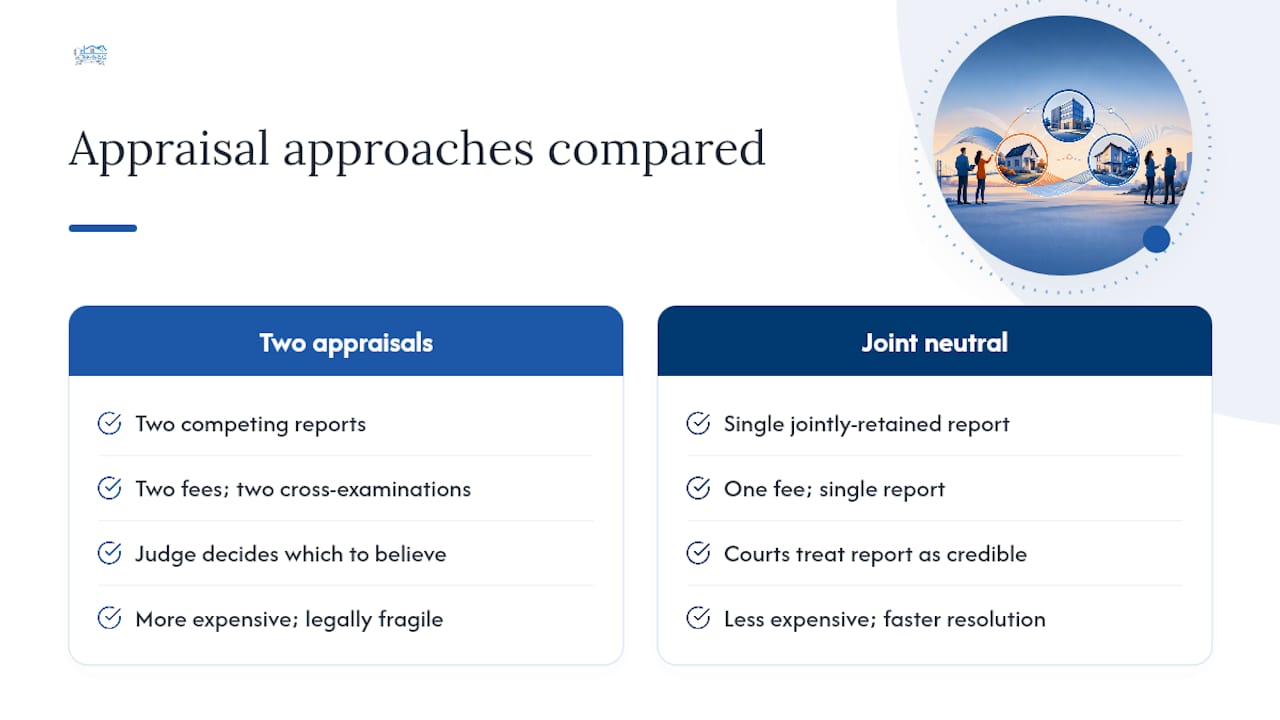
A jointly retained neutral appraiser is typically the most cost-effective and defensible option for NJ divorce and estate matters. Two separate reports cost more, invite dueling cross-examinations, and often end up before a judge anyway.
Pro Tip: If the parties can't agree on a single appraiser, have each attorney submit two names and let the other side strike one. You'll land on a neutral without court intervention.
What legal and USPAP standards make an appraisal court-ready in NJ?
USPAP requires independence, a documented scope of work, and a signed written report; a failure to comply risks inadmissibility. The Appraisal Foundation publishes USPAP and its Advisory Opinions, including AO-34 (retrospective appraisals) and Standard Rule 1-2(b), which governs how appraisers identify the effective date of value.
USPAP Standard Rule 1-2(b) requires the appraiser to identify the effective date of the appraisal. For retrospective assignments, that date falls in the past, and the appraiser must reconstruct market conditions using only data that was publicly available on that date — no subsequent sales or market events may influence the opinion of value.
New Jersey requires state-certified licensure through the Division of Consumer Affairs for any appraisal used in a legal proceeding. The Appraisal Institute's MAI and SRA designations signal advanced training and courtroom credibility, though they are not legally required. The American Society of Appraisers and Appraisers Association of America also credential members whose work appears in NJ courts.
Key compliance checklist:
- State-certified license (NJ Division of Consumer Affairs)
- USPAP-compliant scope of work, signed written report
- Appraiser independence — no financial interest in the outcome
- Correct effective date documented in writing
- Retrospective assignments: data limited to what was publicly available on the effective date
- Willingness to testify and be deposed
How to commission a collaborative appraisal in NJ: step by step
1. Agree on the effective date in writing. For divorce, this is often the complaint filing date or the date of separation. For estate work, it's the date of death.
2. Define the scope of work. Both parties or their attorneys sign off on property type, intended use, report format (narrative), and any special conditions.
3. Select and retain the appraiser. Confirm state-certified status, USPAP compliance, and courtroom experience before signing an engagement letter.
4. Schedule the inspection. Neutral protocol invites both parties to attend, takes the same information from each side, and documents everything for lay-person comprehension.
5. Provide supporting documents. Deed, mortgage history, renovation invoices, prior appraisal reports, HOA documents, leases, and any insurance claims. Confidential financial documents should be shared only through counsel.
6. Review the draft report. Attorneys may flag factual errors (wrong square footage, missing renovation) but cannot direct the appraiser's opinion of value.
7. Receive and serve the final report. Deliver simultaneously to both attorneys to preserve neutrality.
Typical costs and timeline:
| Assignment type | Typical fee range | Turnaround |
|---|---|---|
| Standard residential (divorce) | $400–$700 | 5 business days |
| Retrospective or date-of-death | Higher; varies by complexity | 10 business days |
| High-value or unique property | Higher; varies by complexity | 10 business days |
| Expedited delivery | Add-on fee | 2–5 business days |
Pro Tip: Check key factors that affect NJ divorce appraisals — condition, recent renovations, and timing all influence value and can affect the fee.
How to vet an appraiser: questions and red flags
Credentials to verify:
- Active state-certified license with the NJ Division of Consumer Affairs
- USPAP compliance confirmed in writing
- MAI, SRA, or equivalent professional designation
- Documented courtroom testimony history in NJ
- Professional affiliation: Appraisal Institute, American Society of Appraisers, or Appraisers Association of America
- Errors and omissions insurance
Questions to ask before hiring:
- How many NJ divorce or estate appraisals have you completed in the past three years?
- Are you willing to be deposed and testify in court?
- Have you handled retrospective assignments under AO-34?
- How do you document your scope of work and comparable selection?
- What is your turnaround time, and do you charge for expedited delivery?
- What is your fee, and how do you handle fee-splitting between parties?
Red flags:
- Refuses to sign a USPAP-compliant report
- No courtroom or deposition experience
- Vague or verbal scope of work
- Undisclosed financial relationship with either party
- Unwilling to explain methodology to a non-appraiser audience
- Offers a value opinion before completing the inspection
See what accuracy means in NJ divorce appraisals for a deeper look at credentials attorneys should prioritize.
How valuation disputes get resolved — and how to avoid the appraisal trap
When parties use competing appraisals and the values diverge, resolution options include averaging within an agreed band, commissioning a neutral third appraisal, mediation, or presenting both reports to a judge. Courts sometimes specify averaging rules in their orders; when values are far apart, a third appraiser or court appointment typically resolves the impasse.
The appraisal trap: Lenders cannot accept a private divorce appraisal for mortgage underwriting. If one spouse is buying out the other and needs a new mortgage, the lender will order its own appraisal through an appraisal management company. That lender appraisal may produce a different value, which can derail a settlement built on the private figure.
How to protect yourself:
- Include a refinance contingency in the settlement agreement that accounts for a potential lender appraisal variance
- Add a coordination clause specifying what happens if the lender's value differs materially from the agreed settlement value
- Involve a certified divorce lending professional (CDLP) early, before the settlement is signed
- Time the lender appraisal to run concurrently with the divorce appraisal where possible
Pro Tip: The appraisal trap catches parties off guard most often in buyout scenarios. Address it in the settlement agreement before the ink dries, not after the lender's number comes back lower.
How NJREAG handles court-ready collaborative appraisals
Newjerseyrealestateappraisal (NJREAG) delivers state-certified, USPAP-compliant appraisal reports across all 21 New Jersey counties, with deep specialties in divorce, estate, date-of-death, retrospective, and tax appeal appraisals.
What you get with NJREAG:
- Narrative, court-ready reports formatted for legal proceedings, not mortgage underwriting
- Documented scope of work and comparable selection methodology
- Willingness to testify, be deposed, and respond to cross-examination
- Retrospective appraisal capability under AO-34 and SR 1-2(b)
- Simultaneous delivery to both attorneys for joint assignments
- Estate and date-of-death appraisals for probate and Surrogate's Court submissions
With 26+ years of combined NJ real estate experience, NJREAG understands what judges, attorneys, and lenders need from a valuation report. Call (908) 517-3913 or visit NJREAG's appraisal services page to confirm your effective date and request a quote.
Appraisal commission agreement: a practical checklist
Before signing any engagement letter for a collaborative appraisal, confirm these items are documented in writing:
- Property address and legal description
- Effective date of value (agreed by both parties or ordered by the court)
- Intended use and intended users (e.g., divorce settlement, estate filing, tax appeal)
- Report format: narrative, USPAP-compliant, court-ready
- Inspection protocol: who may attend, how information is shared
- Fee amount and payment terms: who pays, how fees are split, when payment is due
- Confidentiality provisions: how sensitive financial documents are handled and who receives the final report
- Delivery terms: simultaneous delivery to both attorneys, deadline for draft and final report
- Testimony clause: appraiser's agreement to testify or be deposed if required
- Conflict-of-interest disclosure: appraiser certifies no financial interest in the outcome
- Scope of work limitations: any agreed restrictions on data sources or property access
Keep a signed copy with both attorneys and the appraiser before the inspection is scheduled. A verbal agreement on any of these points creates risk.
What most guides on this topic get wrong
The conventional advice is to "get two appraisals and average them." That sounds fair. In practice, it's one of the more expensive and legally fragile paths you can take in a New Jersey divorce or estate matter.
Two competing reports mean two fees, two cross-examinations, and a judge who now has to decide which appraiser to believe. Courts don't average appraisals the way parties imagine. They weigh methodology, credentials, and the quality of the comparable sales analysis. The side with the weaker report often loses more than the value difference between the two numbers.
The research consistently points in one direction: a jointly retained neutral appraiser, properly scoped and dated, produces a single report that both sides can rely on and that courts treat as credible, as explained in the French Riviera Real Estate Appraisal context. It's less expensive, faster, and far less likely to end in a contested hearing.
What attorneys and homeowners underestimate is the effective date. Getting that date wrong, or failing to document it before the appraiser begins work, can make an otherwise solid report inadmissible. For retrospective assignments, the stakes are even higher: one data point from after the effective date can compromise the entire opinion of value under USPAP AO-34.
Hire for courtroom experience first, credentials second, and price last. A $500 appraisal that can't survive cross-examination costs far more than a $900 one that closes the case.
Get a court-ready appraisal from Newjerseyrealestateappraisal

Newjerseyrealestateappraisal (NJREAG) is the direct alternative to managing competing appraisals and the legal exposure that comes with them. We deliver state-certified, USPAP-compliant narrative reports across all 21 NJ counties, with specific experience in divorce, estate, and tax appeal assignments that hold up in court and in front of lenders.
You get a documented scope of work, a signed report, and an appraiser who will testify. We handle retrospective assignments under AO-34, simultaneous delivery to both attorneys, and fee-splitting arrangements. Whether your matter is in Atlantic County, Union County, or anywhere in between, we know the local market and the legal standards your report needs to meet.
Call (908) 517-3913 or request a quote online to confirm your effective date and get started.
This article provides general information about real estate appraisal processes and is not a substitute for legal, financial, or professional appraisal advice. Confirm current USPAP standards and NJ licensing requirements with the Appraisal Foundation and the NJ Division of Consumer Affairs, and consult qualified legal counsel for your specific matter.
Sources
- Home appraisal for divorce settlement: costs and rules - LegalClarity