
A drive-by appraisal values a home from the outside and assumes the inside. An interior appraisal has the appraiser walk through every room. For a refinance with plenty of equity, the first can be enough. When a court, an estate, a tax board or a buyer will rely on the number, the interior appraisal is the one that holds up, because the value rests on what the appraiser saw, not on what the records suggest. We do this work every day for New Jersey homeowners, attorneys and executors, so this article covers how the two types differ, what each costs, and how to match the type to the decision.
TL;DR
- A drive-by (exterior-only) appraisal relies on the outside of the home plus public records and MLS data. An interior appraisal adds a full inspection of the inside.
- Drive-bys cost less and finish faster, but the appraiser must assume the interior condition. Remodeling and hidden damage can both be missed.
- Divorce, estate, date-of-death, tax appeal and sale decisions depend on property-specific evidence. That is what an interior appraisal documents.
- Whoever orders the appraisal, confirm the intended use first, because the report's scope has to match how the value will be used.
Table of Contents
- What each type of appraisal actually is
- How a drive-by appraisal works
- What an interior appraisal adds
- Accuracy: where the two types part ways
- Cost and timing
- When a drive-by is used, and why lenders decide
- Matching the appraisal to your situation
- Before you order: confirm the intended use
- Our perspective
- Get an appraisal built for the decision
- FAQ
- Sources
What each type of appraisal actually is
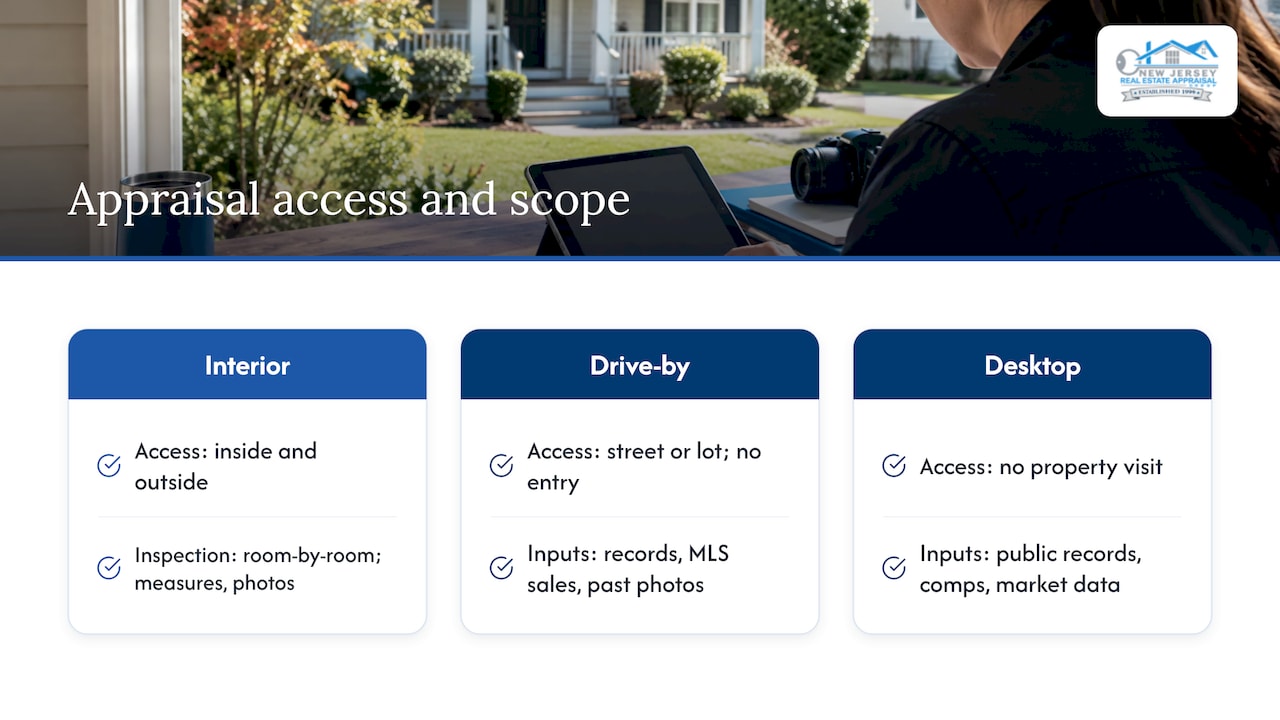
An interior appraisal, often called a full appraisal, has a licensed appraiser inspect the inside and outside of the property, measure and photograph it, and analyze it room by room. The standard report form for this is the Uniform Residential Appraisal Report (URAR, Fannie Mae Form 1004), as Align Lending's explainer notes.
A drive-by appraisal is formally an exterior-only report. The appraiser views the property from the street or lot and does not enter. Redfin describes the inputs as public property records, MLS sales data and past listing photos. The older exterior-only form used for this, Form 2055, is no longer among Fannie Mae's current accepted forms, according to the same Align Lending page.
A third type, the desktop appraisal, involves no visit at all. All three types draw on public records, comparable sales and market data, and Progressive's valuation guide, citing The Appraisal Foundation, says only licensed appraisers can perform them under USPAP, the Uniform Standards of Professional Appraisal Practice. The difference is how much of the property the appraiser has actually seen.
How a drive-by appraisal works
The steps explain both the speed and the limits:
- The order. In lending, the lender orders the report and sets its scope. Chase notes that the borrower usually pays, but the lender decides the appraisal type.
- The records pull. The appraiser gathers assessor and tax data, MLS history, prior listing photos, permits and aerial imagery.
- The exterior visit. The appraiser photographs siding, roof, windows, foundation, driveway, garage and lot, and flags anything that contradicts the records. This visit can take as little as 15 to 30 minutes, per Redfin.
- The neighborhood review. Location influences and nearby sales are evaluated.
- Reconciliation. Comparable sales are weighed into a value. Interior condition is inferred from historical data and market expectations rather than observed.
That last point is the whole story. The report is built on an extraordinary assumption: a stated premise the appraiser cannot verify. Redfin's explainer and a Realtor.com piece both describe the usual one, that the interior is in average condition.
What an interior appraisal adds
Walking through the home lets the appraiser check items the records cannot show. Bomaland's help center lists them:
- Quality of finishes and the condition of appliances
- Damage or deferred maintenance
- The floor plan and total square footage
- Upgrades and renovations, such as a modern kitchen or structural improvements
- Safety hazards or code violations
Public records often lag the house. A finished basement, a rebuilt bathroom or a converted attic may never reach the tax file. A bedroom count can also be wrong. Each of these moves a value, and only someone inside the property can document it.
Our analysis at NJREAG looks past square footage and public records to condition, renovations, workmanship, layout, marketability, location influences, relevant comparable sales and buyer reaction. Most of that list is only visible in person. Our appraisers also bring more than 26 years of appraisal and real estate experience, including hands-on renovation and fix-and-flip work, to judging how a kitchen or bath was finished and what a buyer will make of it.
Accuracy: where the two types part ways
The errors run in both directions. Chase says a drive-by can undervalue a remodeled home because the improvements go unseen, or overvalue a home with interior problems that go unseen. Redfin adds that structural issues, water damage, mold or termite damage can be missed, and that the public data used may be outdated.
The Realtor.com article quotes an appraiser making the same point from the other side: a drive-by matters mainly when a seller has remodeled, because upgrades that would raise the estimate stay invisible.
For a homeowner, that cuts two ways:
- If you put $90,000 into a kitchen and two bathrooms, a number that assumes average condition leaves that money out.
- If a roof leak or foundation problem sits behind the walls, a number that assumes average condition can overshoot, and a number that later has to be defended or corrected costs you more than the time you saved.
If you are weighing a renovation before a sale or valuation, understanding home renovation financing options helps you judge how much of the spend you can expect to see reflected in value. An interior appraisal documents what was actually done.
Cost and timing
Published national ranges show why drive-bys are attractive. Redfin reports drive-bys usually cost $100 to $350, against $300 to $2,000 for a full appraisal, with traditional appraisals taking a week or more in busy markets. iBuyer.com's 2026 guide lists drive-bys at $100 to $150 and full appraisals at $300 to $600, notes the report usually arrives in 3 to 10 business days, and lists rush delivery as a $100 to $300 surcharge.
| Drive-by (exterior-only) | Interior (full) | |
|---|---|---|
| Property seen | Outside only | Inside and outside |
| Interior condition | Assumed | Observed and documented |
| Typical national cost | $100 to $350 | $300 to $2,000 |
| Typical turnaround | A few days | 3 to 10 business days |
| Main use | Lower-risk lending, such as refinances with equity | Purchases, higher-risk lending, legal and tax matters |
Those are national figures from general cost guides. New Jersey fees for legal, estate and tax work are different, because the report is a different product. Our published fees for NJ home appraisals run from $495 to $750, and the estate, divorce and tax appeal reports have their own ranges, listed below.
When a drive-by is used, and why lenders decide
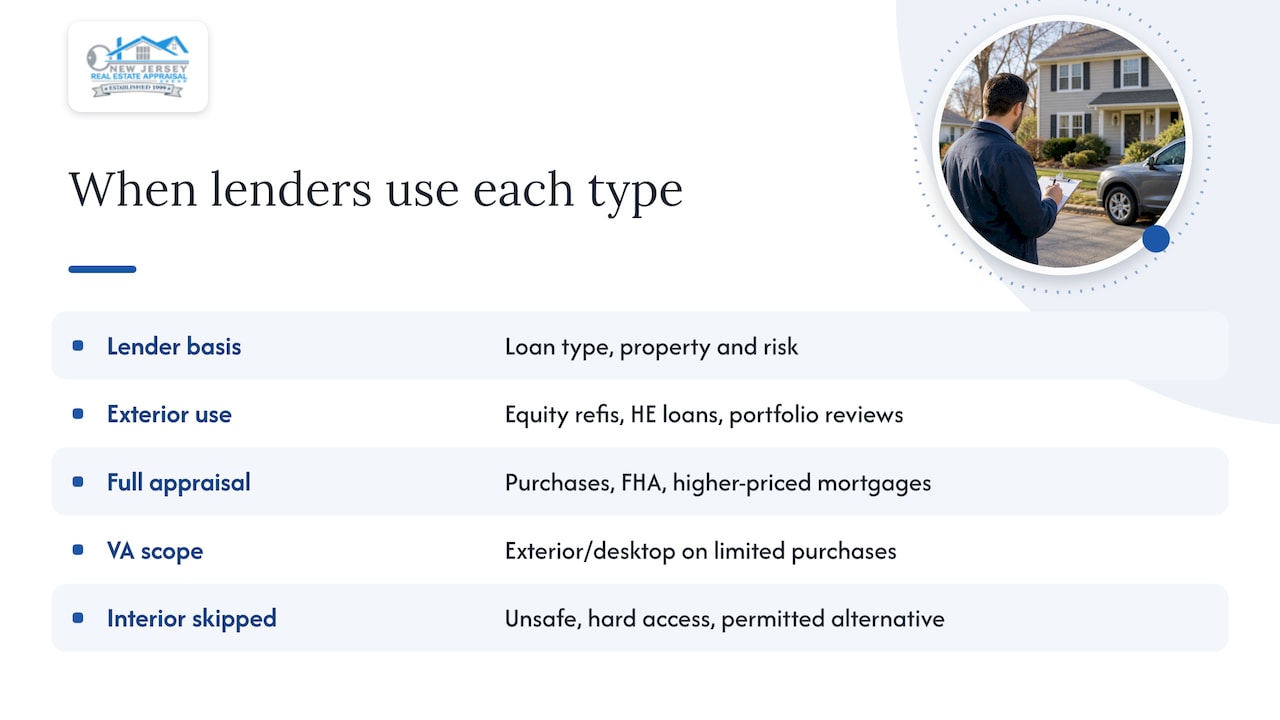
Who picks the type matters. In a mortgage, the lender chooses, based on loan type, property and risk. The Appraisal Foundation, as cited by Progressive, describes it as a risk-based decision. Align Lending says exterior-only reports typically show up in refinances with equity, home equity loans and portfolio reviews, while purchases, FHA loans and higher-priced mortgage loans call for full appraisals.
Federal programs set hard conditions. For VA loans, VA Circular 26-22-13 allows exterior-only and desktop appraisals on purchases only in limited circumstances. They include a lender participating in the LAPP program, a price at or below the conforming loan limit, a one-unit non-condominium home not under renovation, and either a down payment of at least 20% or a case unassigned for more than seven business days. The circular also says an exterior-only value rests on an extraordinary assumption.
Chase adds that interior inspections may be skipped when a house is unsafe or hard to access, or when Fannie Mae or Freddie Mac permits an alternative valuation. A full interior inspection is always an option.
That is lending. A lender's internal risk screen is not the same job as proving a value to a judge, a probate file or a tax board, which is where most of our clients land.
Matching the appraisal to your situation
The question to ask is not which is cheaper. It is who will rely on this number, and what happens if it is wrong.
Divorce and equitable distribution
In New Jersey, the marital home is typically one of the largest assets divided. Each spouse, their attorney, and possibly a mediator or court will test the value. An assumed interior invites an argument from the other side: "the appraiser never saw the house." A report built on a full inspection, with condition and improvements documented, gives attorneys something to stand on. Our court-ready divorce appraisals are priced from $550 to $800.
Estate, probate and date-of-death valuations
Executors and estate attorneys need a value as of a specific date, often for tax basis, distribution among heirs or a buyout of one sibling by another. Heirs rarely agree when the number rests on assumptions. A property-specific, USPAP-compliant report supports the executor's accounting and reduces disputes. Estate and date-of-death reports through our certified estate appraisal service run $595 to $850. Retrospective valuations, which look back to a past date, follow the same logic: the more property-specific evidence, the more defensible the conclusion.
Property tax appeals
A tax appeal asks a board to lower an assessment. The board is looking for evidence that the assessor's view of the property, and its condition, is wrong. Condition, deferred maintenance and layout all feed that argument, and none can be shown from the curb. Our property tax appeal appraisals cost $495 to $750.
Selling, pre-listing and buyouts
A seller who has renovated wants those improvements counted before setting an asking price. A family buyout needs both sides to accept the number. Pre-listing appraisals are $495 to $750. In both cases, an interior-based opinion gives the price a documented basis.
Investors and multi-family owners
For ARV, portfolio or multi-family valuations, the unit-by-unit condition and the scope of the work are the value drivers. An exterior view cannot establish either one.
Refinancing and PMI removal
For an ordinary refinance, the lender decides the report type, and an exterior-only report may be what it orders. If you are removing PMI, the servicer sets the valuation requirements. Ask what they require before ordering anything. We handle PMI removal appraisals; see our services page.
Before you order: confirm the intended use
Whoever pays for an appraisal, the report has to fit its use. Before ordering, settle these:
- Who will rely on the value. A court, a mediator, an estate, a tax board, a buyer or a lender each has its own expectations.
- The effective date. Today's market value, a past date of death and a retrospective date require different analysis.
- The property rights and scope. Single-family, multi-family and land are valued differently, and a legal matter may need the report's scope written into the engagement.
- The standards. Ask that the report be prepared by a state-certified appraiser under USPAP.
- The assumptions. Read what the report says it assumes. An extraordinary assumption about condition is a reason to consider a fuller scope when the value is contested.
Attorneys often handle the first two with the client. We can take the rest: our reports are state-certified and USPAP-compliant, prepared for legal, financial and transaction purposes.
Our perspective
Most of the disputes we see over value start in the same place: someone is arguing about a number that rests on something nobody verified. That could be square footage from an old tax record, a basement nobody measured, or a renovation that lives only in the owner's memory.
A drive-by has a place in lending, where the lender is pricing its own risk. A divorce, an estate or a tax appeal is different. People who disagree will examine the number, so it has to be built on evidence about this property, not an average one.
That is why we put the work into the details: condition, renovations, workmanship, layout, marketability, location influences, comparable sales and how buyers react to the house. Our 26 years in appraisal and real estate, including hands-on renovation and fix-and-flip work, help us read what a finish level or a repair actually does to value. We also use professional data sources and research tools to verify market evidence beyond basic MLS data.
The result is a conclusion that attorneys, executors, CPAs and families can use, because it shows how we got there.
Alek Petreski
Get an appraisal built for the decision
If a court, an estate, a tax board or a buyer will rely on the value of your New Jersey property, start with a report that reflects the whole property. New Jersey Real Estate Appraisal Group provides independent, state-certified appraisals for homeowners, attorneys, executors, accountants, investors and lenders across the state. Home appraisals are $495 to $750, with the divorce, tax appeal and estate fees listed above.

Request a quote through our Home Appraisals in New Jersey page and tell us how the value will be used, so the report is scoped to fit.
FAQ
Is a drive-by appraisal as accurate as an interior appraisal?
It can be close when the home is in typical condition and the records are current. Because the appraiser assumes the interior, remodeling and hidden problems are not reflected. When the value will be used in a legal or tax matter, an interior appraisal gives you property-specific evidence.
Can I choose a drive-by appraisal for my mortgage?
Usually not. For a mortgage, the lender orders the appraisal and decides the type, based on the loan and its risk. You can always ask about options, and a full interior and exterior inspection remains available, according to Chase.
Will a drive-by appraisal hold up in divorce or probate?
Those matters turn on the specific condition and features of the property. A report that assumes the interior leaves room for challenge. A court-ready report built on a full inspection and USPAP-compliant analysis is the safer foundation for attorneys, mediators and executors.
How long does an appraisal take?
National guides put the on-site visit for a full appraisal at 30 minutes to 3 hours, and the written report usually at 3 to 10 business days. A drive-by visit can be as short as 15 to 30 minutes. Timing for your property depends on its size, its complexity and the purpose of the report.
Sources
- Redfin: What is a Drive-By Appraisal and When It Works
- Align Lending: Drive-By Appraisal
- Progressive: Home appraisals vs. other valuation tools
- Chase: Online Home Appraisal vs. Drive-By vs. Hybrid
- Realtor.com: What Is a Drive-By Appraisal?
- Bomaland: Exterior-only and full interior appraisal
- iBuyer.com: Home Appraisal Cost in 2026
- VA Circular 26-22-13
Recommended
- Desktop Appraisal Explained: How It Works and When It Fits
- Types of Real Estate Appraisals: Choosing the Right One
- Save One to Two Weeks: As Is vs Subject To Appraisals Under Fannie Mae
- How to Prepare for a Home Appraisal in NJ
This article is provided for general informational purposes only and does not constitute legal, tax, or financial advice. Real estate appraisal requirements can vary by assignment and intended use. For advice specific to your situation, consult the appropriate legal, tax, or financial professional.