

An industrial property appraisal is a state-certified, USPAP-compliant opinion of value covering warehouses, distribution centers, flex buildings, and manufacturing facilities. Owners and investors order one for four main reasons: financing or refinancing, sale or purchase negotiation, tax appeal, and estate, divorce, or litigation matters. Fees typically run from $2,000 to $4,000 for straightforward warehouse assignments, climbing well past that for complex or special-purpose plants.
You need one whenever a lender, court, tax board, or buyer requires a defensible, third-party number instead of your own estimate.
- Financing and refinance underwriting
- Sale pricing or purchase due diligence
- Property tax appeals
- Estate, divorce, and litigation support
Key Takeaways
A defensible industrial property appraisal pairs a state-certified, USPAP-compliant valuation method with complete documentation and an appraiser who has real industrial experience.
| Point | Details |
|---|---|
| Match the report to its use | Financing, tax appeal, and litigation require a full narrative report; internal planning may only need a restricted version. |
| Prepare documents early | Gather three years of operating statements, leases, site plans, and environmental reports before contacting an appraiser. |
| Income approach usually leads | For leased industrial assets, the income approach typically carries the most weight in the final reconciliation. |
| Budget realistically | Simple warehouse appraisals often start around $2,000 to $4,000; special-purpose plants run considerably higher. |
| Choose NJREAG for defensible results | Newjerseyrealestateappraisal delivers state-certified, USPAP-compliant industrial appraisals across all 21 NJ counties. |
Table of Contents
- What Is an Industrial Property Appraisal Used For?
- Which Industrial Property Types Affect Value the Most?
- What Documents Does an Industrial Appraiser Need?
- Which Valuation Approach Matters Most for Industrial Property?
- How Much Does an Industrial Appraisal Cost and How Long Does It Take?
- How Do You Choose a Qualified Industrial Appraiser?
- Why NJ Property Owners Choose NJREAG for Industrial Appraisals
- What Owners Get Wrong About Industrial Appraisals
- Get a State-Certified Industrial Appraisal From NJREAG
- Sources
What Is an Industrial Property Appraisal Used For?
Lenders order an industrial property appraisal before funding a purchase or refinance. Underwriters need a state-certified opinion of value to set loan terms, and they won't move forward without one that meets USPAP standards.
Sellers use appraisals to support an asking price. Buyers use them to justify a lower offer or walk away from a deal that doesn't pencil out.
Tax appeals, estate settlements, divorce proceedings, and litigation all demand court-ready reports. These assignments require more documentation and a defensible opinion that can hold up under cross-examination, not just a quick valuation for internal planning.
- Purchase and refinance: full appraisal required by underwriting guidelines
- Sale negotiation: supports listing price or counters an inflated offer
- Tax appeal, estate, and divorce: full narrative report built to survive legal scrutiny
- Internal planning only: a restricted or evaluation report may suffice
The intended use dictates the report format. Don't assume a quick desktop review will satisfy a tax board or a judge.
Which Industrial Property Types Affect Value the Most?
Not all industrial buildings appraise the same way. A single-tenant warehouse and a specialized cold storage facility require different comparable sets and different adjustments entirely.
Common subtypes include warehouse, distribution, light manufacturing, flex, cold storage, and heavy manufacturing. Each carries its own value drivers.
- Clear height and column spacing
- Dock door count and truck court size
- Power capacity (three-phase service matters for manufacturers)
- HVAC or temperature control systems
- Environmental history, especially for former manufacturing sites
Specialized assets are where general commercial tools fall short. Factors like proximity to highway or rail access, local labor pools, and technology requirements such as heavy power or climate control can create large value differentials that a generalist appraiser might miss entirely.
Owner-occupied manufacturing plants with embedded equipment sometimes need a separate business or going-concern valuation, splitting real estate value from the operating business. If your property includes heavy fixed equipment, ask upfront whether that carve-out applies to your assignment.
What Documents Does an Industrial Appraiser Need?
Appraisers move faster when you hand them a complete package upfront. Gather these before your first phone call.
- Site plan and building plans or specifications
- Rent roll and copies of all current leases
- Operating statements for the past three years
- Prior appraisals, if any exist
- Recent property tax bills
- Capital expenditure history
- Environmental reports, especially Phase I assessments
- Zoning documentation and any variances on file
Appraisers commonly request this exact documentation set, along with detailed site plans and building specs, to properly evaluate industrial and flex buildings.
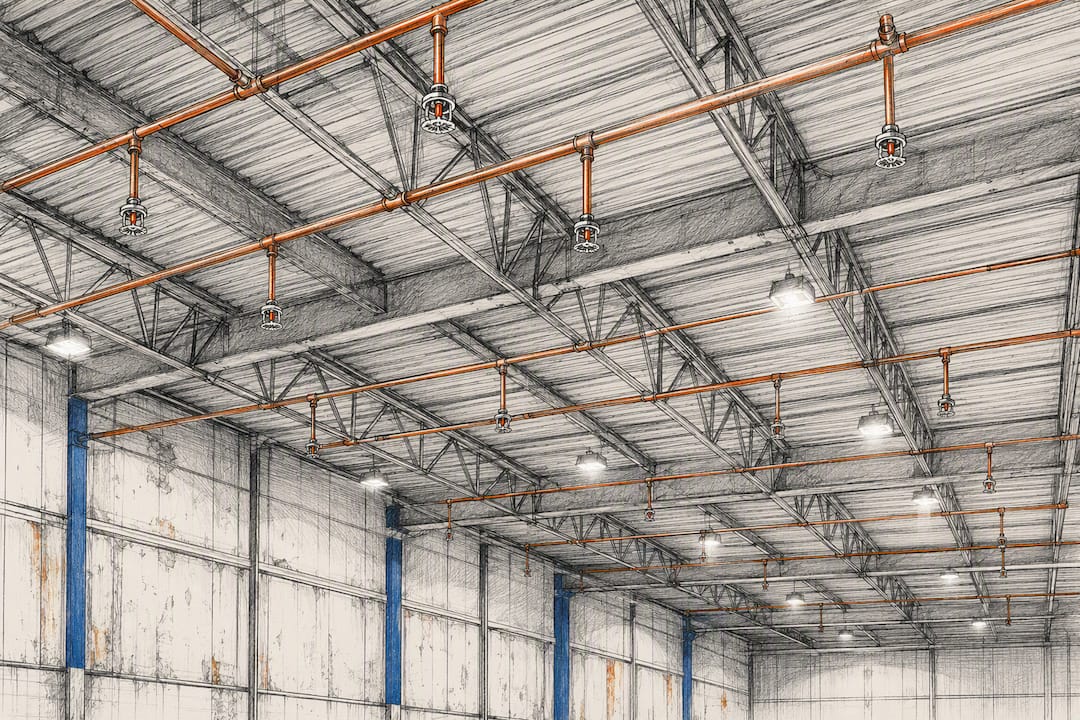
The site inspection covers the roof, slab condition, clear height, loading doors, sprinkler system, electrical capacity, HVAC, and truck circulation patterns. Missing environmental records or undisclosed zoning nonconformities are the two most common causes of delay we see. Learn more about how zoning affects your appraisal before the inspector arrives.
Pro Tip: Pull your last three years of operating statements before you call an appraiser, not after. Incomplete financials are the single biggest reason industrial appraisals run past their turnaround estimate.
Which Valuation Approach Matters Most for Industrial Property?
A defensible industrial appraisal weighs all three approaches to value, but they rarely carry equal weight. Income, sales comparison, and cost each answer a different question.
The income approach builds net operating income from actual or market rents, then applies direct capitalization or a discounted cash flow model. For leased industrial assets with stable tenants, this approach usually dominates the final reconciliation.
The sales comparison approach pulls recent industrial sales and adjusts for differences in clear height, dock count, age, and location. Comps are often scarce for specialized buildings, so adjustments require real judgment, not a spreadsheet formula.
The cost approach estimates replacement cost minus depreciation and obsolescence. It typically dominates for special-purpose or owner-occupied manufacturing plants where comparable sales are thin or nonexistent.
- Income approach: usually leads for leased, income-producing assets
- Sales comparison: supports and cross-checks the income conclusion
- Cost approach: takes the lead for specialized or owner-occupied plants
A defensible commercial or industrial appraisal reconciles all three, but for income-producing industrial assets, the income approach typically carries the most weight. Local market dynamics and building-specific characteristics both drive final value, which is exactly why an appraiser with real industrial experience produces a materially different number than a generalist working outside their lane.
How Much Does an Industrial Appraisal Cost and How Long Does It Take?
Fees scale with complexity. A simple, single-tenant warehouse appraisal typically starts around $2,000 to $4,000. A large special-purpose manufacturing plant with environmental issues or multiple building systems can run considerably higher.
- Simple warehouse or flex space: lower end of the range
- Multi-tenant distribution center: moderate complexity, higher fee
- Special-purpose manufacturing or cold storage: highest fees, longest timelines
When a lender orders the appraisal for a purchase or refinance, the borrower typically pays. That's standard practice, and it's worth confirming upfront rather than assuming otherwise.
Turnaround typically runs two to four weeks for standard assignments. Incomplete records, environmental questions, or specialty equipment analysis push that timeline out further. The fastest way to protect your deadline is submitting a complete document package on day one.
How Do You Choose a Qualified Industrial Appraiser?
Credentials matter more here than in most residential work. Confirm these before you sign an engagement letter.
- Verify the appraiser holds a state-certified general real property license, not just a residential certification
- Ask whether an MAI designation or documented industrial experience applies to your assignment size
- Request redacted sample reports from recent industrial assignments
- Ask for references from lenders, attorneys, or CPAs who've used their industrial work
- Confirm turnaround time and fee terms in writing before you commission the report
- Verify USPAP compliance and clarify how the final report will be delivered
Ask direct questions: how many industrial appraisals has this appraiser completed in the past three years? Do they have experience with SBA, CMBS, or estate-related assignments? How do they handle a property with a known environmental issue?
Pro Tip: If an appraiser can't name a recent industrial assignment similar to yours off the top of their head, keep calling. Generalist commercial appraisers often lack the local logistics knowledge that separates a defensible number from a guess.
Why NJ Property Owners Choose NJREAG for Industrial Appraisals
We're state-certified, USPAP-compliant, and we've handled real estate valuation work across all 21 New Jersey counties for over 26 years. That's not a sales line. It's the baseline every industrial assignment we take on has to meet.
Our specialties include commercial and industrial valuation, estate and date-of-death appraisals, property tax appeals, and litigation support. Courts, attorneys, and tax boards need reports that survive scrutiny, and that's exactly what we build.
- State-certified appraisers on every industrial assignment
- USPAP-compliant, court-ready report format
- 26+ years of combined experience across NJ counties
- Specialties in tax appeal, estate, divorce, and litigation valuation
Have your rent roll, leases, and three years of operating statements ready before you call. It shortens our timeline and yours.
What Owners Get Wrong About Industrial Appraisals
Most owners treat an industrial appraisal like a bigger version of a home appraisal. It isn't. The comps are thinner, the adjustments are more subjective, and a generalist commercial appraiser without industrial-specific experience will often lean too hard on the cost approach simply because it's easier to defend on paper.
That's backwards for most leased industrial assets. If your building has stable tenants and a real rent roll, the income approach should carry the reconciliation, not the cost approach. An appraiser who defaults to replacement cost because comps are scarce is taking the easy route, not necessarily the accurate one.
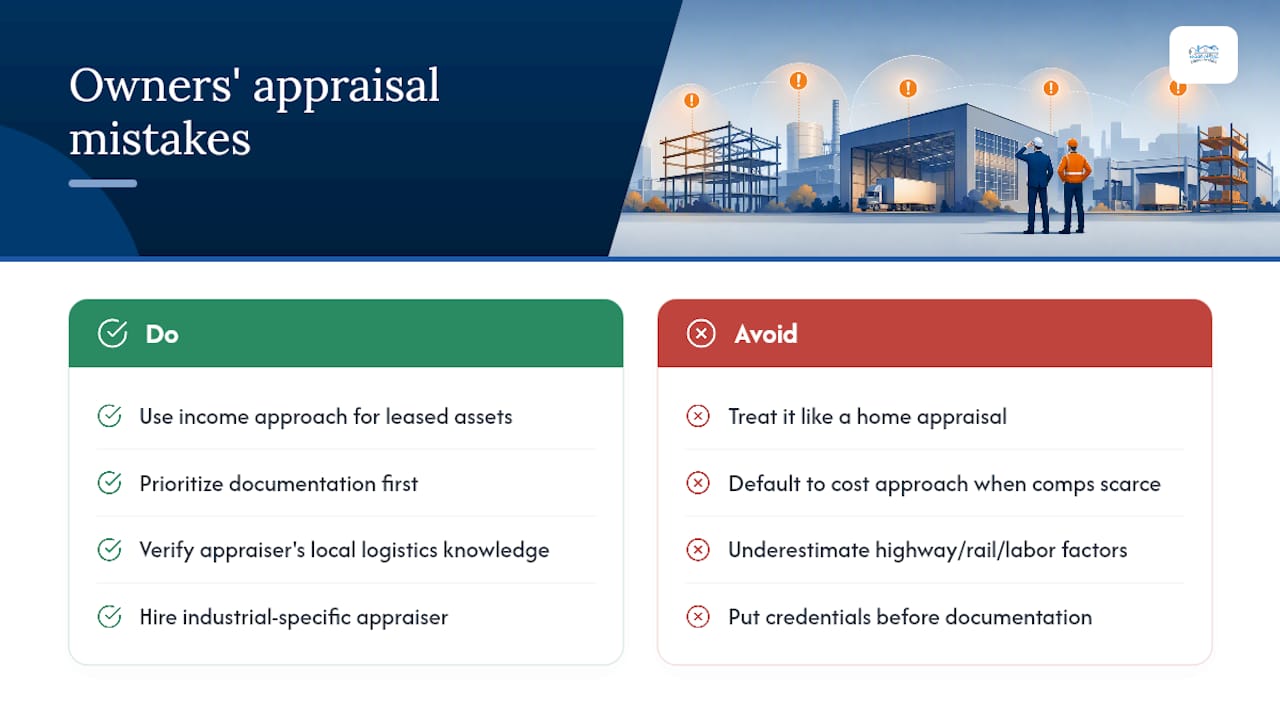
The other blind spot: owners underestimate how much local logistics knowledge matters. Highway access, rail proximity, and labor pool availability separate two seemingly identical warehouses more than square footage ever will. If your appraiser can't speak to those factors specific to your submarket, question whether they've done enough industrial work to get your number right.
Prioritize documentation first, credentials second, and approach reconciliation last. Skip that order and you'll pay for a report that doesn't hold up.
— Alek
Get a State-Certified Industrial Appraisal From NJREAG
Newjerseyrealestateappraisal is the direct path to a defensible number when a lender, tax board, or court needs one that holds up. Unlike a generalist commercial firm juggling residential and retail work, we bring 26+ years of combined experience and coverage across all 21 NJ counties specifically to industrial, tax appeal, estate, and litigation assignments.

If you're preparing for a refinance, a tax appeal, or a legal proceeding involving industrial real estate, we can scope your assignment and give you a fee and turnaround estimate before you commit. Have your rent roll, leases, and recent tax bills ready. Request an appraisal through our Atlantic County appraisal services page or call us at (908) 517-3913 to talk through your property before you commission the report.
Sources
- Appraising industrial properties (Appraisal Institute)
- Appraising industrial and flex buildings: what info do you need? (AppraisalBuzz)
- Who pays for a commercial appraisal and how much? (LegalClarity)
- Commercial Real Estate Appraisals: The 2026 Investor's Complete Guide (Stacking Capital)
This article is general information, not a substitute for advice from a qualified financial advisor. Consult a qualified financial professional about your own circumstances before acting on anything here.