

As executor, your first job is to create and secure court-ready appraisal records that show USPAP-compliant valuations for every significant asset. Courts, the IRS, and beneficiaries all rely on these records, and weak documentation is the most common reason estates face delays, penalties, or litigation. This executor's guide to appraisal records gives you a practical, day-one workflow built around New Jersey probate requirements and federal tax standards.
Move fast on deadlines. Many states impose inventory windows of about two to three months from the date letters testamentary are issued. Check your county surrogate's court rules immediately, because local practice can tighten that window further.
Secure these items on day one:
- Certified death certificate (multiple copies)
- Deeds, titles, and vehicle registrations
- Bank, brokerage, and retirement account statements
- Keys, safe combinations, and safe-deposit box access
- Existing appraisals and insurance policies
- Business ownership documents and operating agreements
Pro Tip: Engage a state-certified, independent appraiser for real estate and high-value personal property within 30 days of your appointment. Waiting longer risks post-death deterioration affecting the date-of-death value conclusion, which can complicate both probate and IRS filings.
Hold all distributions until you have tax clearance. Executors who distribute assets before receiving IRS clearance may face personal liability for later tax shortfalls.

Table of Contents
- What your probate inventory and appraisal records must include
- Which assets need a professional appraisal and which don't
- How to choose a court-ready appraiser: state-certified, USPAP-compliant, and independent
- How to assemble, index, and store your appraisal records
- What probate filing deadlines mean for your appraisal timeline
- Common executor pitfalls and how defensible appraisals prevent disputes
- Step-by-step executor workflow and checklist
- Appraisal costs, who pays, and how to budget
- How Newjerseyrealestateappraisal prepares court-ready estate appraisal records
- Key Takeaways
- What we've learned working with NJ executors
- Useful sources for verifying rules and appraiser credentials
- Newjerseyrealestateappraisal is the right call for NJ executors who need defensible reports
What your probate inventory and appraisal records must include
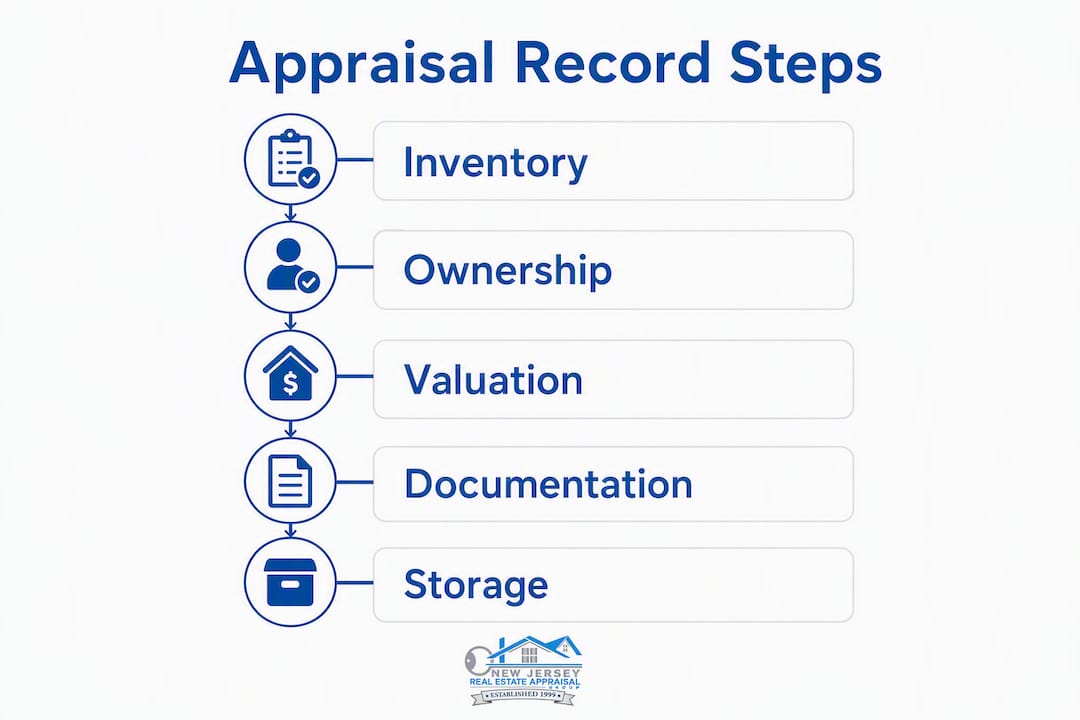
A complete estate inventory maps every asset to its ownership proof, valuation basis, and supporting documentation. The table below shows the minimum required documents by asset category.
| Asset Category | Ownership Proof | Valuation Basis | Supporting Docs |
|---|---|---|---|
| Real property | Deed, title search | USPAP-compliant appraisal (date of death) | Photos, tax record, comparable sales |
| Bank accounts | Statements, signature card | Account balance as of date of death | Bank letter or statement |
| Securities / brokerage | Account statement | Closing price on date of death | Brokerage confirmation |
| Vehicles | Title, registration | Licensed appraiser or NADA/Kelley Blue Book | Photos, mileage, condition notes |
| Business interests | Operating agreement, stock cert | Certified business valuation | Financial statements, tax returns |
| Jewelry / collectibles | Purchase receipt, insurance rider | Specialist appraiser (ISA or ASA credentialed) | Photos, gemological report |
| Digital assets | Account credentials, wallet keys | Market price on date of death | Screenshot, exchange statement |
For each asset, the IRS and probate authorities expect the appraisal report to state the intended use (estate/probate), the effective valuation date, the scope of work, and a signed certification of independence. A report that omits any of those elements can be rejected outright.
Minimum documentation per appraisal file:
- Engagement letter with effective date of value
- Final appraisal report in PDF format
- Comparable sales or market evidence workfile
- Photographs documenting condition at time of inspection
- Receipts or prior appraisals for provenance
- Chain-of-custody notes if the asset changed hands or location
Which assets need a professional appraisal and which don't
Not every item in the estate requires a certified appraiser. Prioritizing correctly saves time and money.
Must appraise (state-certified, USPAP-compliant appraiser required):
- Residential and commercial real estate
- Business interests and partnership shares
- Fine art, antiques, and collectibles above IRS thresholds
- Jewelry and gemstones above IRS thresholds
- Closely held stock and non-publicly traded securities
Usually appraise (qualified appraiser strongly recommended):
- Classic or specialty vehicles
- Antiques near the IRS reporting threshold
- Unique personal property with significant insurance value
Document only (receipts, statements, or market checks acceptable):
- Standard household furnishings and personal effects
- Publicly traded securities (use closing price on date of death)
- Bank and money market accounts (use statement balance)
- Most retirement accounts (use account statement)
The IRS triggers a mandatory qualified appraisal for any non-cash charitable deduction over $5,000 and for estate tax filings on Form 706 when the gross estate exceeds the federal exemption. Probate courts can also order a formal inventory with certified appraisals regardless of estate size. Courts and the IRS routinely reject Zillow estimates, broker price opinions, and dealer verbal quotes as unsupported, so a DIY valuation for real estate or high-value personal property is not a viable option in contested or taxable estates.
How to choose a court-ready appraiser: state-certified, USPAP-compliant, and independent
The appraiser you hire determines whether your records hold up. A USPAP-compliant report must be prepared by an independent, state-certified appraiser using objective market data to determine fair market value as of the date of death. In New Jersey, appraisers are chosen by the personal representative subject to the Superior Court or surrogate's approval in certain cases, and they must be impartial and sworn to appraise to true intrinsic value.
Questions to ask every appraiser before hiring:
- Are you state-certified or licensed in New Jersey for this property type?
- Will the report state the intended use as estate/probate?
- Will you include a signed certification of independence?
- Do you charge a flat or hourly fee? (No contingent or percentage-based fees are acceptable under USPAP.)
- Can you provide a sample estate appraisal report?
- Do you have references from estate attorneys or prior executors?
Trust signals to verify:
- Active license on the New Jersey State Real Estate Appraiser Board lookup
- Professional organization membership (ASA, ISA, or MAI for specialty appraisals)
- No disciplinary history on the license record
- Sample report that includes methodology, comparables, and a signed certification
Pro Tip: Insist on an engagement letter before any inspection. The letter should state the effective date of value (date of death), the intended use, the fee structure, and the appraiser's independence from any financial interest in the estate.
Having complete files ready before the appraiser visits also matters. Death certificates, deeds, tax records, mortgage statements, and prior appraisals reduce turnaround time and eliminate common report delays.
How to assemble, index, and store your appraisal records
A simple spreadsheet index keeps every appraisal file findable and audit-ready. Use these columns as your starting template:
| Column | What to Enter |
|---|---|
| Asset ID | Sequential number (e.g., RE-1, VH-2) |
| Category | Real estate, vehicle, jewelry, etc. |
| Location | Physical address or storage location |
| Owner of Record | Decedent's name and any co-owners |
| Appraisal Required | Y / N |
| Appraiser Name | Full name and license number |
| Report Date | Date of final report delivery |
| File Path | Folder path or cloud link |
| Notes | Pending items, disputes, or follow-up needed |
For each appraisal, store these files together:
- Engagement letter (PDF)
- Final appraisal report (PDF/A format preferred)
- Appraiser's workfile and comparable sales data
- Condition photographs (timestamped)
- Receipts, prior appraisals, or insurance riders
- All correspondence with the appraiser
- Payment records
For digital storage, export every report to PDF/A, maintain two independent backups (one local, one encrypted cloud folder with access limited to you and estate counsel), and use a consistent file-naming convention such as YYYY-MM-DD_AssetID_AppraiserLastName.pdf.
Retain these records for at least five years from the date of filing. When the IRS challenges a valuation, the standard first response is a secondary appraisal supported by the original workfile and comparable data. Hold records longer if litigation is possible or if the estate filed Form 706.
What probate filing deadlines mean for your appraisal timeline
Inventory deadlines vary by state and sometimes by county, but the 60–90 day window common in many jurisdictions is not generous when you factor in appraiser scheduling, report turnaround, and court formatting requirements. In New Jersey, the Mercer County Surrogate's office and other county surrogates publish their own forms and deadlines, so check your specific county's rules before assuming a statewide standard applies.
Key filing distinctions:
- Probate court inventory: Filed with the county surrogate or Superior Court; typically includes a sworn inventory of all assets with supporting valuations.
- IRS Form 706 (Estate Tax Return): Due nine months after the date of death (with a six-month extension available); requires qualified appraisals for non-cash assets above thresholds.
- NJ Inheritance Tax: New Jersey imposes its own inheritance tax; the NJ Division of Taxation's executor guide outlines waiver procedures for releasing NJ bank accounts, stock, and real estate.
Action steps before your first deadline:
- Confirm the inventory due date with your county surrogate's office.
- Verify whether the court requires appraiser appointments to be approved before the appraisal is conducted.
- Confirm whether a family exemption scenario in your estate requires two impartial appraisers.
- Check whether the estate must file Form 706 based on the gross estate value.
Common executor pitfalls and how defensible appraisals prevent disputes
Most executor problems trace back to the same short list of mistakes.
Pitfalls to avoid:
- Relying on automated valuation tools or broker price opinions for real estate
- Using an appraiser with a financial interest in the estate (an agent hoping to list the property, an auction house that will sell the items)
- Distributing assets before receiving IRS tax clearance
- Overlooking digital assets, cryptocurrency wallets, or safe-deposit box contents
- Failing to photograph assets before they are moved, sold, or distributed
A USPAP-compliant report protects you because it documents methodology, property condition, and specific market comparables. When a beneficiary disputes a jewelry valuation, for example, a certified specialist appraisal with gemological documentation and comparable auction results is far harder to challenge than a dealer's verbal estimate. Selecting any appraiser with a financial interest risks invalidation of the report entirely.
If a dispute arises:
- Commission a second independent appraisal from a different certified appraiser.
- Preserve all photographs and chain-of-custody notes.
- Document all communications with beneficiaries in writing.
- Hold a distribution reserve until the dispute is resolved and tax clearance is confirmed.
Pro Tip: Fair market value for probate purposes is not what you expect to get at a sale. Courts emphasize intrinsic market value as of the date of death, which can differ significantly from a quick-sale or liquidation price. Make sure your appraiser understands the intended use before they begin.
Step-by-step executor workflow and checklist
Follow this sequence from appointment through final distribution.
Phase 1: Days 1–30
- Obtain certified death certificate (request at least six copies).
- Secure all physical assets: change locks, collect keys, access safe-deposit boxes.
- Gather deeds, titles, account statements, insurance policies, and business documents.
- Identify all appraisable assets and flag items requiring a state-certified appraiser.
- Engage a state-certified appraiser for real estate and high-value personal property.
Phase 2: Months 1–3
- Receive and review all appraisal reports; confirm each includes intended use, effective date, methodology, comparables, and signed certification.
- Photograph all personal property before any distribution or sale.
- File the probate inventory with the county surrogate by the applicable deadline.
- Open an estate bank account and begin tracking all income and expenses.
Phase 3: Months 3–9
- Prepare and file IRS Form 706 if required (due nine months from date of death).
- File NJ Inheritance Tax return and obtain asset release waivers from the NJ Division of Taxation.
- Respond to any IRS or court questions with the original appraisal workfile and comparables.
- Hold a reserve for potential audit adjustments; do not distribute all assets.
Phase 4: Month 9 onward
- Obtain IRS closing letter or discharge before final distribution.
- Distribute remaining assets per the will or intestacy rules.
- Archive all appraisal records, correspondence, and tax filings for at least five years.
Items that must block distributions until resolved:
| Blocking Item | Why It Blocks Distribution |
|---|---|
| Real estate transfer not complete | Title cannot pass until deed is recorded |
| Form 706 unresolved | IRS may assess additional tax against estate assets |
| Contested valuation | Distribution could prejudice beneficiaries or trigger personal liability |
| NJ Inheritance Tax waiver not issued | NJ assets cannot legally be released without waivers |
Appraisal costs, who pays, and how to budget
Appraisal fees are an ordinary and necessary estate administration expense, paid from estate assets before distribution. The estate, not the executor personally, bears the cost.
Typical fee structures by asset type:
- Residential real estate (single-family, condo): Flat fee, typically in the range of a few hundred dollars for standard assignments; complex properties or multi-family buildings cost more.
- Commercial real estate: Hourly or flat fee; complexity, size, and income documentation drive the range significantly higher than residential.
- Fine art, jewelry, or specialty collectibles: Hourly rates from a credentialed specialist (ISA or ASA member); gemological testing or provenance research adds to the total.
- Business interests: Certified business valuations are among the most expensive; expect a wide range depending on entity complexity and financial record quality.
USPAP prohibits contingency fees or percentage-of-value arrangements. Any appraiser who quotes a fee tied to the outcome of the appraisal is not USPAP-compliant and should not be hired for estate work.
Pro Tip: Request an engagement letter that includes an estimated fee range, a list of what is included (inspection, report, workfile), and a clear statement about additional costs such as travel, specialty testing, or rush fees. This protects the estate from billing surprises.
For pulling comparable sales to support a real estate appraisal, a qualified appraiser will source data from MLS records, public deed transfers, and county assessor files. Understanding how that process works helps you evaluate whether the appraiser's methodology is thorough.
How Newjerseyrealestateappraisal prepares court-ready estate appraisal records
Newjerseyrealestateappraisal (NJREAG) delivers state-certified, USPAP-compliant date-of-death appraisals for residential, multi-family, and commercial properties across all 21 New Jersey counties. Every assignment is handled by a state-certified appraiser with no financial interest in the estate.
Every NJREAG estate appraisal report includes:
- Engagement letter with the effective date of value (date of death) and intended use statement
- State certification and USPAP compliance statement
- Signed certification of appraiser independence
- Detailed valuation methodology and scope of work
- Comparable sales workfile with market analysis
- Photographic documentation of property condition
- Appraiser qualifications and license information
- Retention of the original workfile for audit response
Pro Tip: Ask NJREAG for a case review before you commit. We'll confirm whether the property type, timeline, and county fit our standard turnaround, and we'll give you a fee estimate before any engagement letter is signed.
With over 26 years of combined real estate experience across New Jersey, we've worked directly with estate attorneys, CPAs, and executors in Bergen, Essex, Middlesex, and every other NJ county. Our reports are built to withstand IRS scrutiny and probate court review.
Call (908) 517-3913 or visit our estate appraisal services page to request a case review and fee estimate.
Key Takeaways
A defensible executor's appraisal record requires a USPAP-compliant report from a state-certified, independent appraiser, filed before probate deadlines and retained for at least five years.
| Point | Details |
|---|---|
| Act within 30 days | Engage a state-certified appraiser for real estate and high-value assets within 30 days to preserve date-of-death condition. |
| USPAP compliance is mandatory | Courts and the IRS require reports that document methodology, comparables, and a signed independence certification. |
| Hold distributions until clearance | Executors who distribute before IRS clearance risk personal liability for tax shortfalls. |
| Retain records at least five years | IRS challenges typically require the original workfile and comparable data; retain longer if litigation is possible. |
| Newjerseyrealestateappraisal | NJREAG provides state-certified, court-ready date-of-death appraisals across all 21 NJ counties for executors who need defensible records. |
What we've learned working with NJ executors
Most executors we work with are not real estate professionals. They're family members or trusted friends who've been handed a legal responsibility at one of the most difficult times in their lives. The paperwork pressure is real, and the deadlines don't pause for grief.
What we've seen consistently is that the estates that move through probate cleanly are the ones where the executor secured a certified appraisal early, kept a complete file, and didn't distribute anything until the tax picture was clear. The ones that stall, or end up in court, almost always involve a missing document, an informal valuation, or a premature distribution. A defensible appraisal record isn't bureaucratic overhead. It's the evidence that protects you personally and keeps the estate on track.
Useful sources for verifying rules and appraiser credentials
Before you hire an appraiser or file an inventory, confirm current requirements from primary sources. Rules change, and county-level practice can differ from the statewide standard.
Authoritative sources to check:
- The Appraisal Foundation (USPAP): The governing body for USPAP standards; use to verify what a compliant report must contain.
- NJ Division of Taxation — Executor's Guide: Covers waiver procedures for NJ bank accounts, stock, and real estate; outlines inheritance tax obligations.
- Mercer County Surrogate's Office: Example of county-level executor duties and inventory requirements; check your own county's surrogate for local forms and deadlines.
- NJ State Real Estate Appraiser Board: Verify an appraiser's license status, license number, specialization, and disciplinary history.
- American Society of Appraisers (ASA) — Find an Appraiser: Directory for credentialed personal property and business valuation appraisers.
- International Society of Appraisers (ISA) — Find an Appraiser: Directory for jewelry, fine art, and collectibles specialists.
When verifying an appraiser's license, confirm:
- Active license status (not expired or suspended)
- License number and classification (certified residential, certified general, or specialty)
- Any disciplinary actions or complaints on record
- Whether the appraiser's specialty matches the asset type you need valued
Save PDF copies of every license lookup result and any court rule pages you reference. If the estate is later audited or contested, those records show you exercised due diligence in selecting a qualified appraiser.
Newjerseyrealestateappraisal is the right call for NJ executors who need defensible reports
Probate in New Jersey moves on a tight timeline, and a rejected or incomplete appraisal can set the entire estate back by months. Newjerseyrealestateappraisal delivers state-certified, court-ready estate and date-of-death appraisals built specifically for executors who need reports that hold up to IRS review and surrogate court scrutiny.

Every report we produce is USPAP-compliant, signed by a state-certified appraiser, and includes the methodology, comparables, condition photos, and independence certification that courts and the IRS require. We cover all 21 NJ counties, including Atlantic County and Union County, and we work directly with estate attorneys and CPAs to keep the process moving.
Call (908) 517-3913 or request your estate appraisal today to get a case review and fee estimate.
This article provides general information about estate appraisal and probate procedures. It is not legal, tax, or financial advice. Confirm current rules and deadlines with your county surrogate's office, a licensed New Jersey attorney, or a qualified CPA before making decisions about your estate administration.